Visiting a watering hole over the hottest week of the year
07.07.26
07.07.26
The Global Water Stewardship Forum, organised by the Alliance for Water Stewardship, is a ‘watering hole’ for companies working on the twin water and climate crisis and a great place to meet potential collaborators in our work in south Asia and east Africa. Jon Shepherd shared his insights on the train home from Edinburgh after a week of ‘water talk’ with some of the most significant companies supporting action on the water crisis today.
It has been a difficult time for the charity sector as a whole over the last couple of years with the closure of USAID and the reduction of DfID leading to a huge reduction in overseas development assistance. One presenter commented that 2025 saw the largest reduction in aid ever seen in one year. Although we do not take government funding, this has led to a general reduction in funding for all work with the poorest globally.
As one organisation stated at the meeting, NGOs are facing:
- Constrained funding and the collapse of the aid architecture;
- Shrinking civil space, declining freedoms and rising risks to defenders;
- Pushback against inclusion and participatory governance
It’s because of these challenges that NGOs like Frank Water are increasingly working in new ways with new funders. The Frank Water Institute (FWI), launched this year, is a great example of this. FWI does two things that are outside of our 20 years’ experience of working with small holder farmers and remote communities to secure water.
Firstly it works with companies, like Apple Inc., to provide ‘environmental services’, which in normal english means helping companies better understand their water and how to improve their use of it. Examples could be risk mapping of supply chain sites, water use improvements or helping convene local action outside of the companies factories.
Secondly, FWI helps local NGOs and governments to improve their water management and through this increase their ability to make lasting change. The most recent example of this is the FWI’s Certificate in Applied Water Management, attended by over 400 people from over 50 countries. This course brings hydrology to the local level, where water projects are being done and where small NGOs and local governments need more knowledge to make sustainable plans.
Some of the FWI’s work has been supported by ERM Foundation and, as you know, we’ve worked with Arup for many years. At this meeting we rekindled conversations with Apple Inc and others and the next few years are looking positive in terms of our collaborations with companies who are supporting action to help the poorest communities gain access to water.
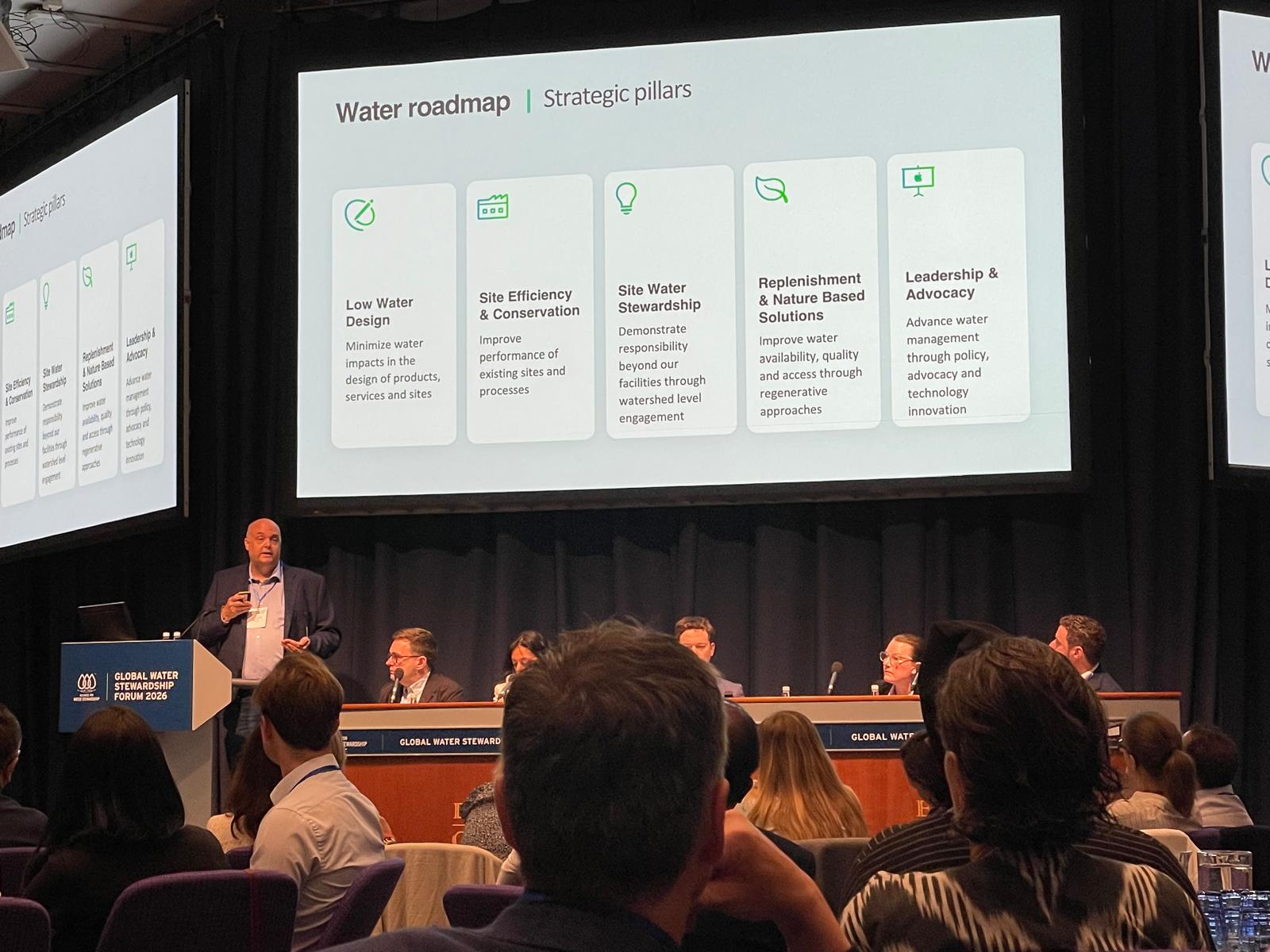
Presenter discussing water roadmap at Global Water Stewardship Forum
Later this year, the UN Water Conference will be another level of action to bring water to the attention of governments across the world but with so much going on in the world, it is a constant effort of NGOs like FW to keep these issues at the forefront of our minds.
Whilst I was in Edinburgh this week, my daughters were supposed to be in school but the heat was so intense that their school was closed. The first time that anyone can remember this happening. For me this was another ‘canary dying in the mine’ and a call to action for all of us working on water and climate change.
We must redouble our efforts and look for new ways to speed up action – if that means working with new and sometimes unexpected partners, we must find ways to make it work.